
How to Ensure Your Financial Data Meets Regulatory Reporting Requirements
Last updated: 6th July 2026
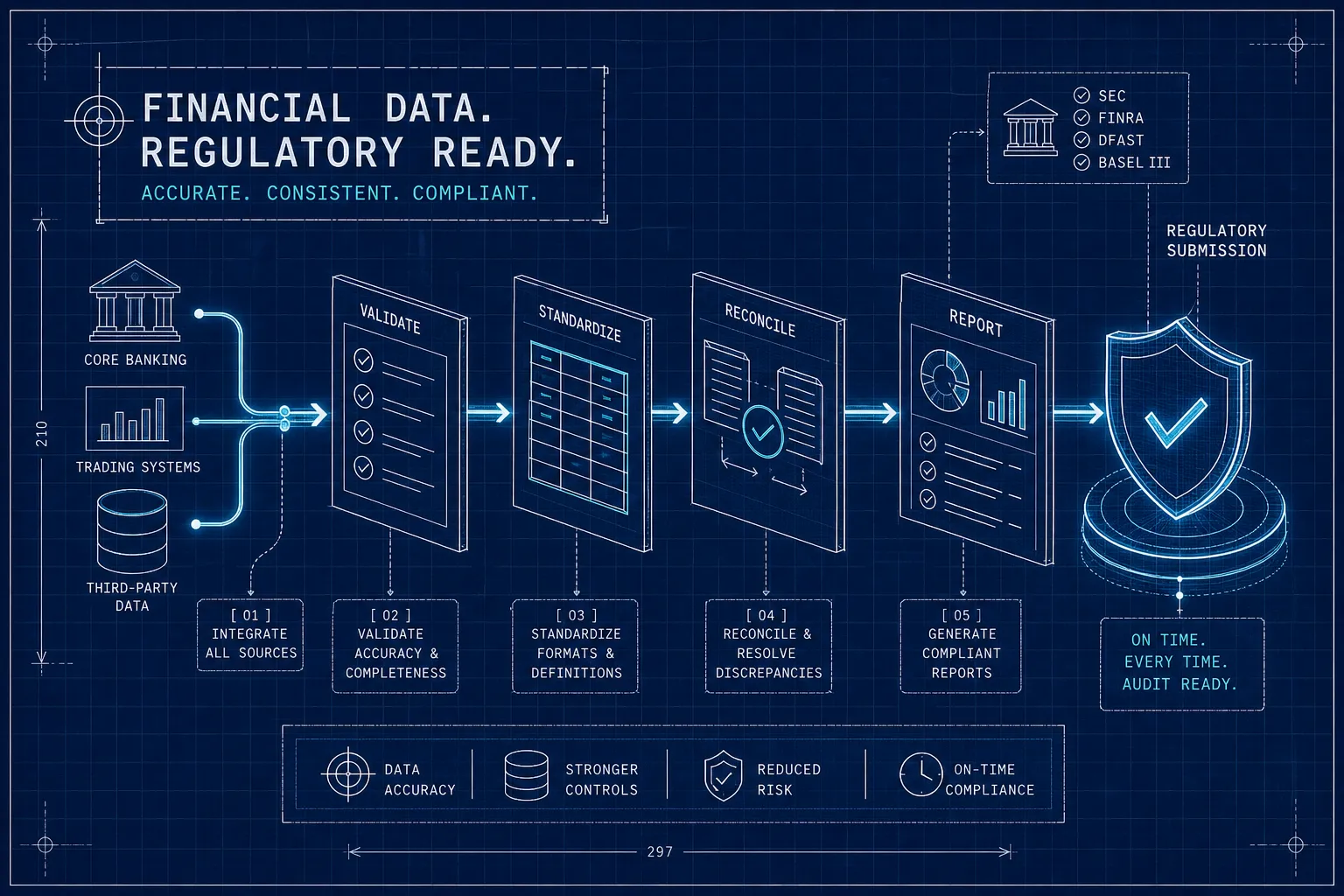
If you’ve ever asked, “How do I ensure my financial data meets regulatory reporting requirements?”, you’re not alone. It’s the question finance and compliance teams raise before every submission cycle, and the answer rarely comes down to knowing the rules. Most submission failures trace back to data that was never properly governed in the first place. After working with finance teams across the industry at DQ Pursuit, I’ve seen the same root causes appear again and again: ownership gaps, undocumented controls, and validation that starts too late in the process.
The pressure is real in 2026. SEC filing formats continue to evolve, SOX attestations demand documented controls, and banking regulators are applying closer scrutiny to the data quality behind reported figures, not just the figures themselves. The proposed Form 10-S semiannual reporting option and updated filercategory thresholds add another layer of change that finance teams need to absorb without dropping existing obligations.
What “regulatory-ready financial data” actually means goes far beyond running a final check before you click submit. It means your data is governed, validated, reconciled, and traceable at every step between source systems and the final filing. This guide covers each of those control areas in a practical sequence, including how no-code platforms are removing the IT bottleneck that has historically made compliance harder than it needs to be.
What regulators actually look for in your financial data
The core data quality dimensions that make or break a submission
Regulators evaluate submissions through five non-negotiable data quality dimensions. Completeness means every mandatory field is populated with zero omissions. Accuracy means your reported figures match the source systems they came from. Consistency means the same values appear across all systems, reports, and prior periods. Validity means the information conforms to required formats, domains, and business rules. Timeliness means data reflects the correct reporting cutoff, not yesterday’s snapshot or last week’s extract.
These are not abstract ideals from a textbook. They are the specific controls regulators check when they review or audit a submission. Based on industry guidance and common practice among regulated institutions, financial data quality management best practices typically aim for accuracy targets in the 95 to 98 percent range, while some insurance contexts require 100 percent. Any gap between where your data quality sits and those benchmarks is a gap that becomes visible when a regulator looks closely.
Ensuring your financial data meets regulatory reporting requirements: filing formats and submission rules
Public companies currently file three Form 10-Qs and one Form 10-K each fiscal year. For large accelerated and accelerated filers, 10-Q deadlines fall at 40 days after the period end; non-accelerated filers have 45 days. The SEC’s May 2026 proposal introduces an optional Form 10-S semiannual reporting option, which would replace some quarterly filings with one semiannual report per year while retaining the annual 10-K. The proposed 10-S would mirror existing disclosure requirements, including interim financials, MD&A, risk factors, and inline XBRL tagging.
Inline XBRL tagging is a required element for most SEC filings, consult current EDGAR guidance for which forms apply, and this is where upstream data problems become downstream filing failures. Wrong taxonomy tags, mismatches between your HTML presentation and tagged facts, incorrect sign conventions, and omitted line-item tags all trace back to information that was never properly validated before reaching the filing stage. For guidance on tagging expectations and common pitfalls, see industry resources on inline XBRL tagging. For banking and securities contexts, FFIEC Call Reports and brokerdealer FOCUS reports carry their own submission formats and deadline structures. Each carries the same core requirement: your data must be complete, accurate, and internally consistent before it goes out.
How a governance framework makes your reporting defensible
Assigning clear ownership over regulated data
A governance framework without named accountability is not governance, it’s documentation theater. Regulators expect to know who owns the data, who is responsible for its quality, and who signed off on the figures before submission. In practice, that means defining data owners accountable for accuracy, data stewards who handle day-to-day quality and issue resolution, and a governance committee that sets and enforces the standards everyone else operates within.
The absence of these roles is one of the most common gaps finance teams discover during pre-audit reviews. When an auditor asks “who is responsible for this figure,” the answer cannot be “the system” or “the team.” A named owner with documented accountability is what turns a reported number into a defensible one.
Policies, standards, and business glossaries that survive scrutiny
A well-designed data governance policy covers the sourcing rules for regulated data, the definitions of your critical data elements (CDEs), classification levels, retention requirements, and escalation paths for data issues. That last item matters more than most teams realize. When a quality problem surfaces two days before a 10-Q deadline, you need a documented process for resolving and approving the fix, not a frantic email chain.
A maintained business glossary ties every reported field to a definition, a system of record, and a named owner. When an auditor questions a line item, the governance documentation is the first thing they ask for. If your glossary is outdated or your CDEs are undefined, that conversation gets uncomfortable fast.
The validation and reconciliation controls you need before every submission
Pre-submission validation rules that catch errors at the source
Validation rules should operate at every layer of your data pipeline, not just at the submission point. The categories that matter for data quality in regulatory reporting include: mandatory-field checks for every required identifier and amount; format and type checks for valid dates and numeric-only fields; range and reasonableness checks against expected thresholds; cross-field logic checks such as confirming start dates precede end dates and sign rules are applied correctly; and cross-system matching to confirm figures align between source records and your general ledger.
Every failed rule should route to a tracked exception process, and that process must produce a documented resolution record. Exceptions that disappear into a spreadsheet, get fixed quietly, and leave no trace are the same exceptions that become audit findings later. A validation framework that surfaces issues without recording their resolution is only half a control.
Reconciliation tie-outs and how to document variances
The three most critical reconciliation controls in financial reporting are subledger-to-ledger reconciliation, trial balance tie-outs, and intercompany matching. Each operates with defined tolerance thresholds that reflect materiality and transaction type. A difference within tolerance may be accepted; a difference outside tolerance must be investigated, documented, and approved before submission proceeds.
The documentation of the reconciliation process is just as important as the reconciliation itself. Regulators want evidence that the control was performed, by whom, when, and what happened with any exceptions. An output showing a clean tie-out is useful. A controlled, documented process showing how you reached that clean tie-out is what makes your reporting defensible under scrutiny.
What an audit-ready data lineage trail actually looks like
Building end-to-end traceability from source to report
A defensible lineage design operates across four layers. The source layer captures system-of-record logs and identifiers. The transformation layer holds ETL job logs, validation outputs, and reconciliation records. The governance layer maintains a lineage catalog with ownership metadata and change approvals. The evidence layer is an immutable audit store with exportable inspection packets that can be produced on demand.
Partial lineage covering only the final step before submission is a recurring finding in financial reporting audits. If you can trace a number from the filing back to the consolidation layer but not back to the source transaction, you have a gap that regulators will flag. Complete, end-to-end coverage is the standard, not an aspirational target. For practical approaches to documenting data lineage for regulatory audits, teams should capture both automated metadata and human approvals tied to each mapping change. Historical lineage must also reflect what existed during the audit period, not what your current mapping looks like after last quarter’s system migration.
Designing audit logs regulators will actually accept as evidence
A regulator-accepted audit log is tamper-evident, self-describing, and queryable on demand. Tamperevident means the log is stored in an append-only or cryptographically hashed system so any alteration is detectable. Self-describing means every event record includes an event ID, the actor who performed it, a precise timestamp, before and after values where relevant, and the control outcome. Queryable means you can pull a complete history for any field, record, or process without a week-long IT request.
A practical way to structure your audit response is to prepare an inspection packet: a cover document for the report or metric in question, the end-to-end lineage diagram, the critical field mapping, job run evidence, reconciliation results, and change-control records for the period under review. Retention periods for audit logs must match the applicable regulatory obligation, requirements vary by regulator and record type, so confirm the specific rules for SEC, FFIEC, or other governing bodies relevant to your filings. A log you cannot produce because it was purged too early is the same as a log that never existed.
How no-code platforms like DQ Pursuit let finance teams own compliance without IT
Why finance teams can’t afford to wait on IT for every data quality fix
The structural problem is familiar. Finance and compliance teams identify data issues close to submission deadlines, then wait on IT to write validation queries, fix pipelines, or generate exception reports. The dependency isn’t a reflection of anyone’s competence; it reflects the fact that traditional data quality tools were built for engineers, not business users. The result is submission risk, last-minute workarounds, and a recurring cycle that leaves teams perpetually reactive.
The cost of that cycle compounds quickly. Poor financial data quality contributes to restatements, regulatory fines, failed audits, and damaged credibility with both regulators and investors. When the data quality function lives entirely inside IT, finance teams lose the ability to act on problems they can see clearly and understand completely.
How DQ Pursuit’s no-code workflow supports data quality for regulatory reporting
DQ Pursuit is built around a three-step workflow: Identify, Control, Correct. Finance and compliance teams use a pre-built rules library to configure validation checks against their critical data elements, run automated assessments across source systems, and surface exceptions in a clear control dashboard, without writing a single line of code. The workflow is designed for the business user who owns the data: the person closest to it and most accountable for its accuracy.
Validation runs are traceable, issue resolution records are time-stamped, and cross-system consistency checks generate documentation that supports audit review, all within the platform, without a separate documentation process. When a 10-Q deadline is 40 days out, you need tooling that operates at the speed of your reporting cycle, not the speed of an IT sprint queue. That is the gap DQ Pursuit was built to close.
A practical pre-submission checklist for regulatory reporting compliance
A reliable pre-submission process addresses five control areas every cycle. First, governance readiness: confirm that your CDEs are identified, owned, and defined, and that your business glossary reflects the current reporting period. No field in your submission should lack a definition and a named owner.
Second, validation coverage. Automated rules should be running against every mandatory field and critical calculation, with all exceptions routed to a documented resolution process, not left open at submission time. Third, reconciliation sign-off: subledger-to-ledger and cross-system reconciliations must be completed within tolerance, with out-of-tolerance variances documented, investigated, and formally approved before the filing goes out.
Fourth, lineage and evidence. End-to-end traceability must be captured from source systems to the final report, and your audit trail must be immutable, complete for the reporting period, and exportable in a format that supports a regulator inspection. Fifth, your documentation package: policy references, control attestations, reconciliation sign-offs, and the inspection packet for the period in question should all be assembled before submission, not after a comment letter arrives.
Regulatory readiness is a continuous discipline, not a presubmission sprint
How do you ensure your financial data meets regulatory reporting requirements? Not by solving it in the week before a deadline. Regulatory readiness is a continuous discipline built on governance infrastructure, validated information, reconciled figures, and traceable evidence that exists because the controls run every day, not just before filing season. The teams that get this right don’t work harder during submission cycles; they work from a foundation that makes those cycles manageable.
Finance teams don’t need to build this foundation from scratch, and they don’t need to route every quality issue through IT to get there. DQ Pursuit’s Identify, Control, Correct workflow gives finance and compliance teams direct control over the validation, monitoring, and documentation that reporting submission requirements demand, without the technical overhead that has historically kept data governance inside IT. For further context on the broader regulatory landscape and recent rulemaking, see analysis of the SEC’s proposed reforms to registered offering and filer status frameworks.
If you want to see how that workflow applies to your own regulatory reporting environment, request a demo of DQ Pursuit and walk through how the platform handles your specific CDEs, submission cycles, and compliance documentation needs. Your next deadline is already on the calendar.
Experience DQ Pursuit for Yourself
Discover the power of confident and business-ready data on your own personal demo.