
Cross-System Consistency Validation for Enterprise Data
Last updated: 29th June 2026
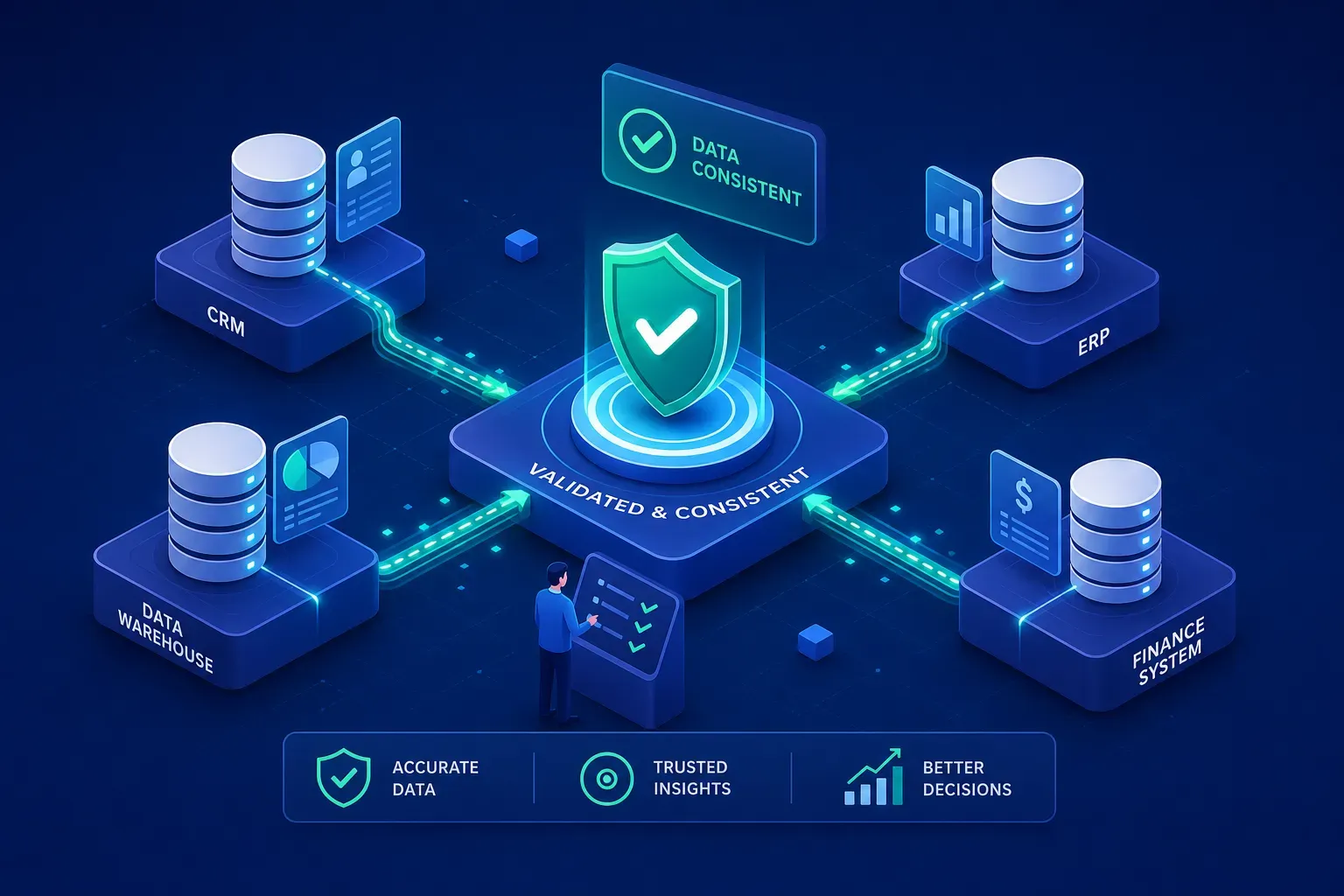
Finance closes the books and reports one revenue figure. The CRM shows a different total. The data warehouse has a third number entirely. Every analyst in the room knows this scene, and none of them can explain it quickly. Cross-system data consistency validation for enterprises exists precisely to prevent this kind of conflict, the kind that delays closes, triggers failed audit samples, and anchors strategic decisions to numbers that were never quite right. That disagreement is not a software bug or a one-time anomaly. It is a governance failure.
Closing the gap between what different enterprise systems believe to be true requires more than better ETL scripts. It requires a structured approach to multi-system data validation: one that assigns ownership, encodes rules, automates detection, and routes issues to the people who can fix them. Platforms built around the Identify, Control, Correct workflow have given enterprise teams a practical way to do exactly that, replacing reactive firefighting with an ongoing consistency discipline. This guide gives you the blueprint.
Why cross-system data mismatches are an enterprise liability
The structural reasons systems drift apart
Enterprise systems are built independently, maintained independently, and updated on different schedules. An ERP vendor ships a schema change that renames a customer status field. The CRM team does not find out for two weeks. By then, the nightly sync has been propagating the old values into a data warehouse where downstream reports now silently disagree with the source. No error fires. No alert triggers. The inconsistency just accumulates.
Schema drift is the most insidious root cause because it does not look like a failure. Transformation logic, naming conventions, data types, and hierarchy definitions all evolve inside each system according to that system’s roadmap, not an enterprise standard. Add asynchronous synchronization windows, departmental tools that were never designed to integrate, and manual data entry that introduces format inconsistencies, and the structural conditions for cross-platform data integrity failures are always present. For additional context on common causes and mitigation approaches to preserve cross-system alignment, see this article on cross-system data alignment.
The real cost organizations absorb
Manual reconciliation is the most visible cost. Analysts spend hours each month-end tracing discrepancies across systems that should agree but do not. Those hours do not go toward analysis or decision support; they go toward data janitor work that a well-governed system should handle automatically. The operational friction compounds: reporting timelines compress, exception queues grow, and the business waits on data that should already be clean. For regulated industries, the stakes are higher. Banks, insurers, and healthcare organizations operating under FDIC, SEC, CMS, or HIPAA requirements cannot produce inconsistent records and explain it away as a sync lag. Inconsistent data across systems is audit exposure, and audit exposure is legal and financial risk. The organizations that treat enterprise data reconciliation as a governance discipline rather than a technical afterthought are the ones that close faster, audit cleaner, and decide with more confidence. For more on aligning compliance and quality controls, consult the Regulatory Compliance & Data Quality Whitepaper, DQ Pursuit.
The governance foundation every multi-system environment needs
Defining ownership before writing a single validation rule
Cross-system data consistency validation fails when it is scoped as a technical project. The real prerequisite is governance: clear answers to who owns the source-of-truth definition for each critical field, and who is accountable when systems disagree. Without those answers, a mismatch alert fires and the response is a three-department email thread with no resolution owner.
Data stewardship, in practical terms, is not a job title. It is a responsibility that business teams hold for the data their processes generate and depend on. Enterprises that assign domain ownership by system, and define that ownership in writing before any validation rules are configured, reduce the time it takes to resolve cross-system mismatches significantly. When a finance steward owns the definition of “recognized revenue” and knows which system is authoritative, the path from alert to fix is direct rather than circular. Embedding stewardship as an accessible practice, rather than burying it in onboarding, helps; see our Knowledge-Based Learning, DQ Pursuit resources for practical steward enablement.
Building validation policies that apply across systems
Governance without documented policy is just intent. Effective multi-system data governance requires enterprises to formalize consistency requirements: acceptable mismatch thresholds for each domain, transformation rules between systems, and authoritative system designations by field. A customer identifier owned by the CRM should not be overwritten by a downstream warehouse ETL process. That rule needs to be written down and enforced, not assumed.
Standardizing naming conventions, data types, and hierarchy definitions across platforms is what makes automated consistency checks trustworthy. Platforms like DQ Pursuit support policy definition at the critical data element level, giving data stewards a structured way to encode cross-system standards without writing a single line of code. When policy lives in the platform rather than a shared document that no one updates, it actually governs something. To get started with practical rule sets and governance patterns, review the Data Quality Best Practices Guide, DQ Pursuit.
How to implement cross-system data consistency validation for enterprises
Batch reconciliation and checksum-based detection
Batch reconciliation compares full datasets after a synchronization window, confirming that record counts, key fields, and aggregate totals match between source and target. It is the right tool for validating that a nightly load from an ERP to a data warehouse landed completely and correctly, and it provides the row-level detail that audit teams need when they want to trace exactly which records diverged. Checksum and hashing approaches operate faster: instead of comparing every row, they compute fingerprints over partitions or tables and flag divergence instantly. When you are validating millions of records across a warehouse and multiple operational systems, hashing delivers the speed that row-byrow comparison cannot. The trade-off is precision. Hashing tells you that something diverged; batch reconciliation tells you what diverged and where. The two patterns work best in combination: hashing for fast detection, reconciliation for the audit trail. For frameworks and approaches to reconciliation at scale, see this practical reference on data reconciliation frameworks.
Change data capture comparison and semantic matching
Change data capture validation checks that inserts, updates, and deletes applied to a source system are correctly and completely reflected in downstream targets. For enterprises running near-real-time replication environments, CDC comparison is the right validation layer because it operates on the change stream itself rather than periodic snapshots, catching missed events before they age into permanent inconsistencies. Learn more about the technical mechanics of what change data capture (CDC) is and how it is used for replication and validation.
Semantic matching operates at the business-meaning level. A status field coded “ACTIVE” in one system and “1” in another will pass a format check but fail a semantic consistency check, because the two systems do not actually agree on what they are saying about that customer. For enterprises with multiple source systems feeding a shared reporting layer, semantic matching catches the domain-level drift that checksum and count-based checks miss entirely. It is the validation pattern that answers not just “do the values match?” but “do the systems mean the same thing?”
How to design validation rules that catch real problems
Starting with critical data elements
Not every field carries equal business risk, and enterprises that try to validate everything end up maintaining thousands of low-value rules while the fields that drive financial reporting, trigger downstream workflows, or appear in regulatory submissions get lost in the noise. CDE identification is a scoping exercise, not a comprehensive audit. The question is: which data elements, if consistently wrong across systems, would materially affect compliance, operations, or financial reporting? The most useful CDEs for cross-system validation have multiple system touchpoints, clear business definitions, high downstream impact when inconsistent, and observable lineage. Tracing how a field moves from source to downstream systems, where it is transformed, and who owns it at each stage is the prerequisite for writing rules that actually validate business correctness rather than technical format.
Rule categories that cover the consistency spectrum
Once scope is defined around CDEs, three rule categories address the full range of cross-system data consistency requirements:
- Format and type rules: Do matching fields use consistent data types, date formats, and value domains across systems?
- Referential integrity rules: Does every foreign key or linked record in one system have a valid counterpart in the authoritative source system?
- Business logic rules: Does a calculated value in a downstream system, such as a balance, a status, or a total, match what the source system would produce using the same inputs?
DQ Pursuit’s pre-built rules library covers all three categories out of the box. Teams configure crosssystem checks without building rules from scratch, which matters enormously when the alternative is a months-long engineering project just to define the validation logic. Speed-to-value is not a marketing phrase for resource-constrained data programs; it is the difference between a governance program that ships and one that stalls in backlog.
Operationalizing cross-system data consistency validation across departments
The metrics that make consistency measurable
Governance without measurement is invisible. Enterprises tracking cross-system consistency need a defined KPI stack: mismatch rate (the percentage of records that disagree between systems), freshness lag (how old synchronized data is at any point), mean time to detect (MTTD), and mean time to fix (MTTR). Each of these metrics needs a threshold that defines normal, a threshold that triggers an alert, and a threshold that constitutes a severity-one data incident.
Industry benchmarks commonly cited for critical data domains suggest mismatch rates below 0.1% for high-value operational fields, freshness lag within 15 minutes for high-velocity pipelines, and MTTR under four hours for severity-one data issues. These targets are not arbitrary. They reflect the tolerance that regulated industries and fast-close finance teams actually operate within. Setting your SLAs against them gives your governance program enforceable standards rather than aspirational ones. For guidance on drafting operational SLAs for data, consider these data SLAs best practices.
Validation cadence and escalation protocols
Cadence decisions follow data latency requirements. A financial close process may need daily batch reconciliation plus real-time drift alerts on key balance fields. A customer master validation may need weekly checks with monthly trend reporting. Mapping cadence to the actual decision cycle of each business process keeps validation overhead proportional to risk without creating alert fatigue from overmonitoring low-priority fields.
Escalation design is where most programs underinvest. When a mismatch threshold is breached repeatedly across consecutive validation cycles, automated escalation to the accountable data steward prevents inconsistencies from aging undetected. Escalation only works, though, if ownership is defined. The governance foundation built in the first phase of the program is what makes the operational layer function when it matters most.
Choosing a validation platform built for enterprise scale
What separates an enterprise-ready platform from a point tool
At enterprise scale, platform evaluation comes down to five criteria. First, pre-built validation rule coverage that eliminates months of custom development. Second, no-code accessibility so business teams can configure and monitor checks without engineering support. Third, integration breadth across ERP, CRM, cloud data platforms, and flat files. Fourth, audit-ready lineage and traceability. Fifth, workflow automation for issue resolution that routes problems to the right owner without a manual handoff. Platforms that require heavy engineering lift to configure rules or set up integrations undermine the speed-to-value that enterprise data programs need. If only data engineers can operate the tool, data governance remains a backlogged ticket rather than a shared practice.
Several platforms in the market handle reconciliation. The real evaluation question is whether the platform is operationally accessible to data stewards and business analysts, not just the data engineering team. For regulated industries, demonstrating how a number was validated is as important as the validation result itself, which means a platform’s audit and reporting capabilities are a compliance requirement, not a nice-to-have.
How DQ Pursuit delivers cross-system consistency validation out of the box
DQ Pursuit was built around the Identify, Control, Correct workflow, and that structure maps directly onto what cross-system data consistency validation for enterprises actually requires. The Identify phase surfaces inconsistencies using automated checks against pre-built rules, giving teams an immediate view of where their connected systems disagree without requiring custom rule development. The Control phase gives data stewards dashboards that track mismatch rates and drift trends across systems, making consistency measurable and manageable at the domain level.
The Correct phase routes discrepancies to the right owner with enough context to act, without requiring an IT ticket or a manual investigation. When business analysts and finance teams can configure, monitor, and resolve cross-system checks themselves, data governance stops being a bottleneck and starts being a daily operating discipline. No-code design is not just an accessibility feature; it is the structural requirement for a consistency program that scales beyond the data engineering team. DQ Pursuit delivers that out of the box, across industries, without a months-long implementation. For additional perspectives on maintaining cross-system consistency over time, see this overview of data consistency.
Building a consistency practice that actually holds
Multi-system data consistency validation is not a project you complete and close. It is an ongoing governance discipline. The enterprises that sustain it have four things in place:
- Clear ownership over every critical data element
- Documented policies that define which system is authoritative and what constitutes an acceptable match
- Automated detection that runs continuously rather than at quarter-end
- Measurable SLAs that make the program accountable rather than aspirational
The technology barrier to building that discipline is lower than most organizations assume. Pre-built rules, no-code configuration, and integrated issue resolution workflows mean that a well-scoped implementation can deliver value in weeks rather than quarters. The investment is not primarily in the platform. It is in the governance decisions: who owns what, what constitutes truth, and what happens when systems disagree.
Get those decisions made and encode them in a platform that enforces them automatically. The result is faster financial closes, cleaner regulatory audits, and a single authoritative version of the data that the entire organization can act on with confidence. That last outcome is harder to quantify than a mismatch rate, but it is the one that changes how organizations make decisions. See how DQ Pursuit can help your team get there.
Experience DQ Pursuit for Yourself
Discover the power of confident and business-ready data on your own personal demo.